 Marusuke's Naruhodo Lab日本語
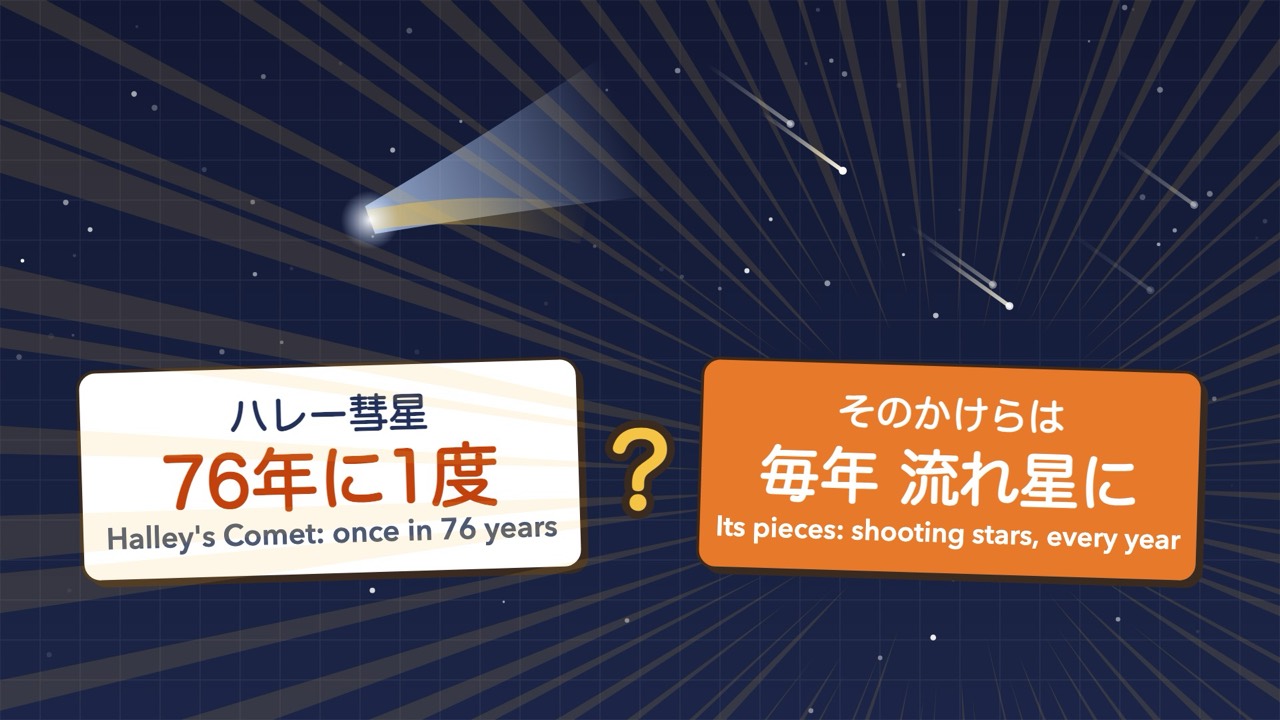
Halley's Comet comes once every 76 years, so why do its pieces become shooting stars every year?
Halley's Comet comes near Earth only once every 76 years. Its last visit was in 1986, and the next will be in 2061.
And yet, pieces of it show up every year as shooting stars, always at the same time of year.
If the comet itself comes only once every 76 years, why do its pieces come every year?
First guess
“Because shooting stars are glowing dust from Halley's Comet?”
Half right. The Orionids' dust does come from Halley's Comet. But that alone doesn't explain why it happens every year.

Answer
Because the dust a comet sheds stays along its path like a ribbon, and Earth crosses that ribbon at the same time every year.
Even though the comet itself comes only once every 76 years, the dust ribbon is always there, so we see it every year as the Eta Aquariids in May and the Orionids in October.
What's more, one study calculated that most of the dust glowing today was shed by Halley's Comet thousands of years ago.
Watch the video (6 min 9 sec)
Chapters (18)
- 0:00Once in 76 years, yet every year?
- 0:54First report, rejected
- 1:09A comet: a lump of ice and dust
- 1:41The dust stays along its path
- 1:56Earth crosses the dust ribbon every year
- 2:23Halley isn't the only source
- 2:44Quiz
- 2:5866 km per second
- 3:15Glowing 100 km up
- 3:28When was this dust dropped?
- 3:43Dust over 3,000 years old
- 4:02The paths don't cross
- 4:26Meeting ancient pieces every year
- 4:37Why they spread from Orion
- 4:56Best time to watch in 2026
- 5:17Tips for watching
- 5:31What we learned
- 5:49How old will you be in 2061?
Full transcript
0:00Once in 76 years, yet every year?
NaruHalley's Comet comes around only once every 76 years. And yet, pieces of it show up every single year, as shooting stars.
NaruIt last came by in 1986. Next time is 2061. The comet itself won't be back for a long, long time.
NaruSo why do just its pieces show up every year? And always at the same time of year?
NaruEven the Director was scratching his head. He had no idea there were meteor showers connected to Halley's Comet.
DirectorGo find out!
NaruHe wants me to find out why it happens every year.
NaruThe answer lies in something left behind in space.
NaruThis year, its pieces light up the most around October 22nd. At the end, I'll tell you when to watch.
0:54First report, rejected
NaruFirst report! A shooting star is a speck of space dust that glows. And the dust of the Orionid meteor shower comes from Halley's Comet!
DirectorRejected!
Naru...He says I still haven't explained why it's every year.
1:09A comet: a lump of ice and dust
NaruOkay, let's start over with Halley's Comet. A comet is a lump of ice and dust. Halley's solid core is about 15 kilometers long.
NaruIt's named after the English astronomer Edmond Halley. He predicted it would return in 1758, and it did. But Halley died before he could see it.
NaruWhen a comet nears the Sun, the heat turns its ice into gas, and dust blasts out along with it.
1:41The dust stays along its path
NaruThat dust doesn't scatter right away. It spreads out along the comet's path, like a long ribbon.
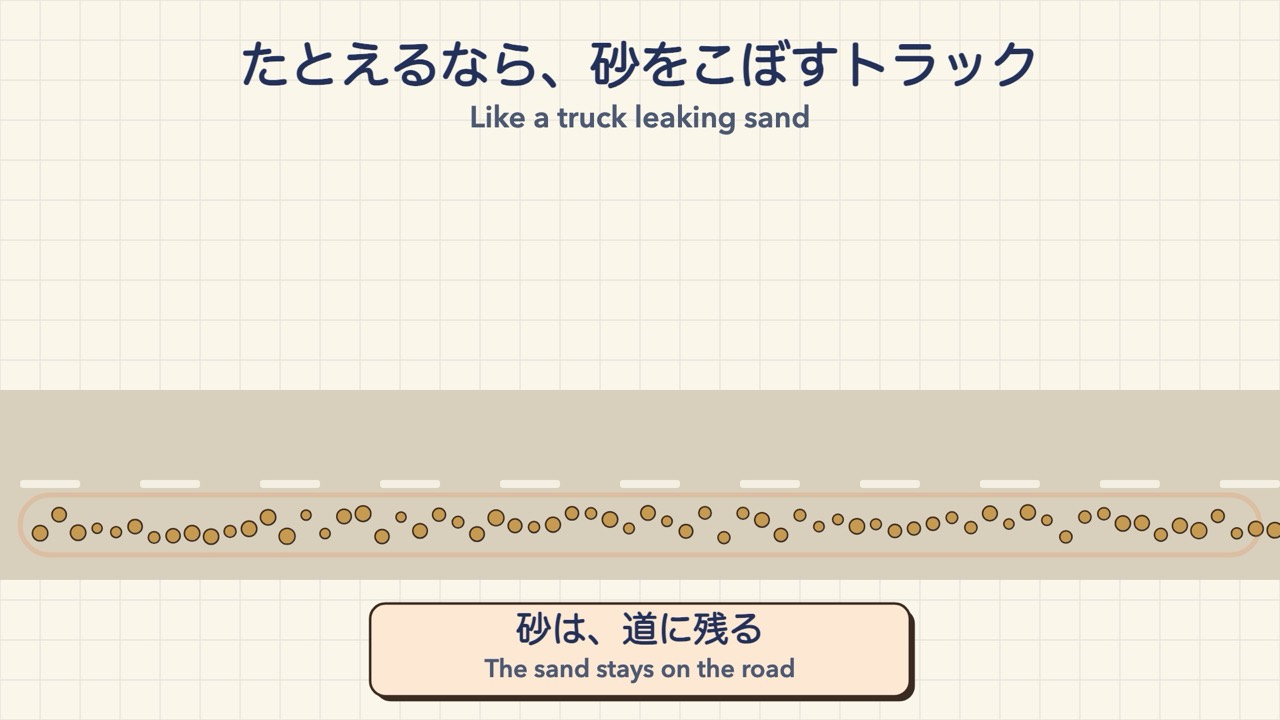
NaruThink of a truck leaking sand as it drives. Even after the truck is gone, the sand stays on the road.
1:56Earth crosses the dust ribbon every year
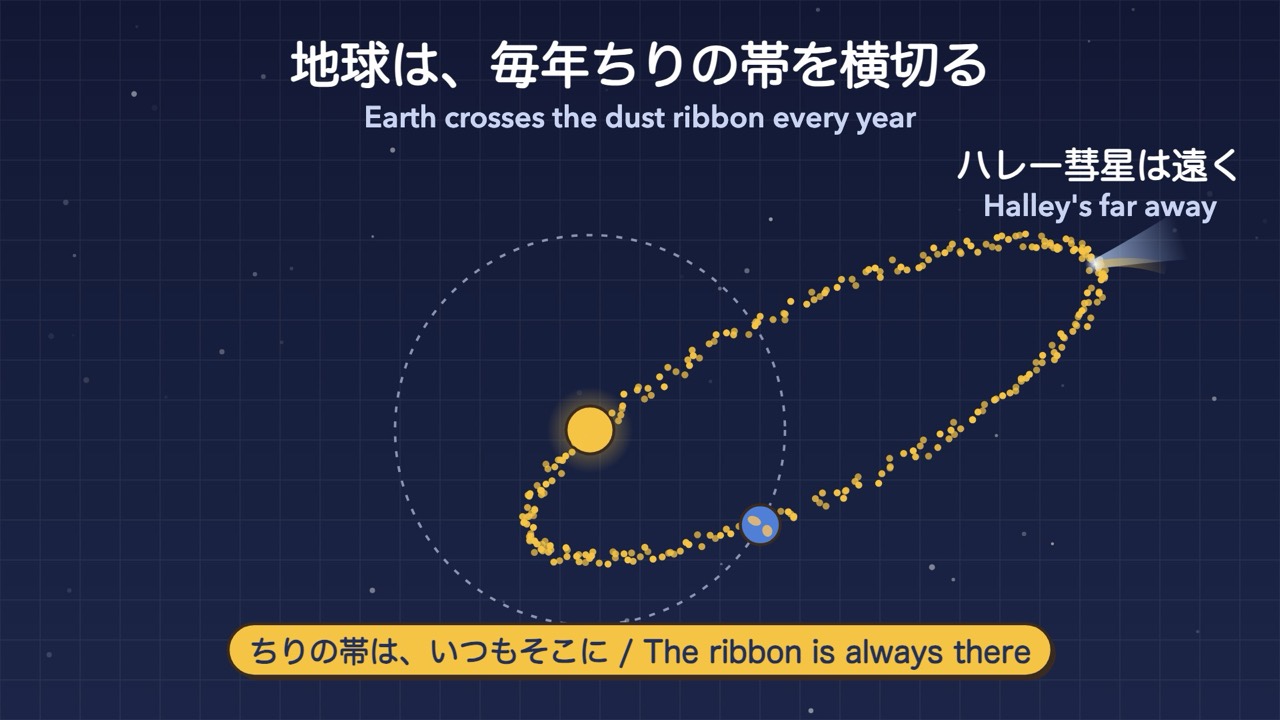
NaruAnd as Earth makes its yearly trip around the Sun, it crosses that ribbon at the same time every year.
NaruHalley's Comet itself may come only once every 76 years, but the dust ribbon is always there.
NaruThat's why we get to see it every year!
NaruAnd Earth crosses it twice a year: in May for the Eta Aquariids, and in October for the Orionids.
2:23Halley isn't the only source
NaruBut Halley's Comet isn't the only source of shooting-star dust. August's Perseids come from a different comet. And some shooting stars don't belong to any shower at all.
NaruBut there are still mysteries. How fast does this dust come in? And when was it dropped?
2:44Quiz
NaruQuiz time!
NaruAt the speed this dust hits our air, how long would it take to fly from Tokyo to Osaka?
NaruThe answer is B: about six seconds.
2:5866 km per second
NaruThat's about 66 kilometers per second, or roughly 240,000 kilometers per hour.
NaruIt's that fast because Halley's Comet goes around the Sun in the opposite direction to Earth. The dust and Earth meet almost head-on.
3:15Glowing 100 km up
NaruAbout 100 kilometers up, the dust heats the air around it until it glows. And it only lasts an instant.
NaruIn Japan, they say to make a wish three times before it fades. Good luck with that!
3:28When was this dust dropped?
NaruSo when was the dust we're seeing now dropped?
NaruIn 1986, the last time Halley's Comet came by?
NaruNo. Much, much earlier.
3:43Dust over 3,000 years old
NaruIn 2006, the Orionids put on a much bigger show than usual.
NaruResearchers at Japan's National Astronomical Observatory ran the numbers. That dust was shed by Halley's Comet as far back as 1266 BC.
NaruThat dust was more than 3,000 years old.
4:02The paths don't cross
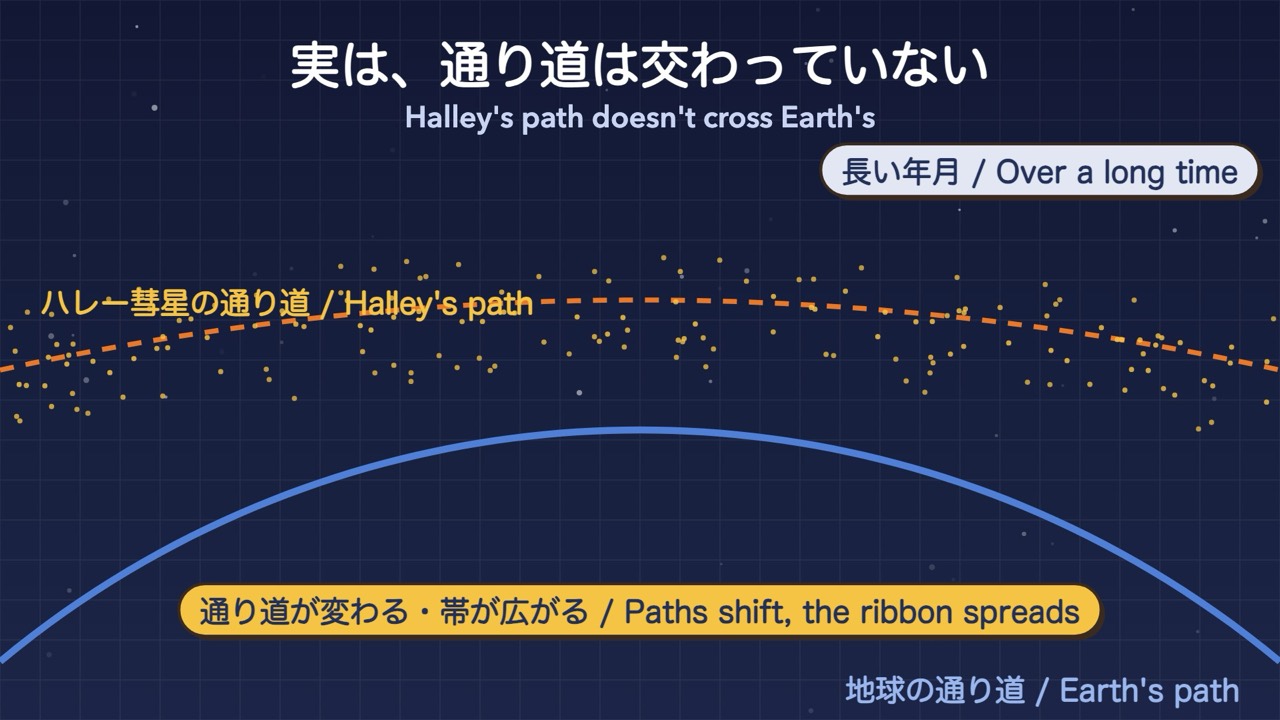
NaruHere's the thing: right now, Halley's path doesn't actually cross Earth's path.
NaruOver a very long time, the dust dropped long ago shifts its path and the ribbon spreads out, until part of it overlaps Earth's path.
NaruOne study calculated that even in normal years, most of this dust was shed thousands of years ago.
4:26Meeting ancient pieces every year
NaruHalley himself never got to see the return he predicted. But we get to meet pieces of his comet from thousands of years ago, every single year.
4:37Why they spread from Orion
NaruOrionid meteors seem to burst outward from around the constellation Orion. That's where the name comes from.
NaruBut really, the dust all flies in parallel, in the same direction. Just like railroad tracks seem to meet far away, the meteors look like they spread from one point.
4:56Best time to watch in 2026
NaruAs promised, here's the best time to watch this year.
NaruThe peak is around October 22nd. The best viewing is from late night until dawn, for a few days around then.
NaruWhere it's dark enough to see the Milky Way, you might see up to five to ten an hour. Once the Moon sets before dawn, they're even easier to see.
5:17Tips for watching
NaruMeteors can show up anywhere in the sky. Give your eyes about 15 minutes to adjust to the dark, and take in as much sky as you can.
NaruYou don't need a telescope or binoculars. They only shrink how much sky you can see.
5:31What we learned
NaruWhy can we see pieces of a once-every-76-years comet every year? Because its dust ribbon is always there. And that dust is something Halley's Comet dropped thousands of years ago. Naruhodo!
Director...Naruhodo.
NaruAnd the Director approved it!
5:49How old will you be in 2061?
NaruHow old will you be when Halley's Comet comes back in 2061? And if you spot a shooting star, tell us in the comments.
NaruAnd please subscribe!
See it in pictures

More details
Why do comets drop dust?
A comet is a lump of ice and dust. The core of Halley's Comet is about 15 km long.
As it nears the Sun, heat turns the ice into gas, which blasts out dust along with it. That dust doesn't scatter right away; it spreads out along the comet's path like a ribbon.
Where does the name Halley come from?
From the English astronomer Edmond Halley. He predicted the comet would come back in 1758, and it did. But Halley had died before he could see it.
Halley never saw the return he predicted. Yet we get to meet pieces of his comet from thousands of years ago, every year.
Does all shooting-star dust come from Halley's Comet?
No. August's Perseids come from the dust of another comet (109P/Swift-Tuttle), and some meteors belong to no shower at all.
How fast does the dust come in?
About 66 km per second, or 240,000 km per hour. At that speed, you'd cover the roughly 400 km between Tokyo and Osaka (in a straight line) in about 6 seconds.
It's so fast because Halley's Comet orbits the Sun in the opposite direction to Earth, so the dust and Earth meet almost head-on. At about 100 km up, the dust heats the air around it and glows for just an instant.
Why do they seem to fly out from Orion?
Orionid meteors seem to shoot out in every direction from around the constellation Orion. That's where the name comes from.
In reality, all the dust flies in parallel, in the same direction. Just as railway tracks seem to meet at one point in the distance, the meteors appear to spread out from a single point.
How can you see them?
In 2026, the Orionids peaked around October 22, with the best viewing from late night to dawn for a few days around that date. Where it was dark enough to see the Milky Way, you could see up to about 5–10 per hour, and viewing got easier once the Moon set before dawn.
Shooting stars can appear anywhere in the sky. Give your eyes about 15 minutes to adjust to the dark, and look up at a wide stretch of sky. You don't need a telescope or binoculars; they only narrow what you can see.
 Takeaway
We can meet pieces of a once-every-76-years comet every year: the dust ribbon is always there, and the dust is something the comet dropped thousands of years ago.
How we checked
- National Astronomical Observatory of Japan, sky guide for October 2026 (Japanese)
- NASA, "Orionids"
- NASA, "Comet 1P/Halley"
- NASA, "Perseids"
- Column by Jun-ichi Watanabe, NAOJ, on the 2006 outburst (Japanese)
- Egal et al. (2020), "Modeling the past and future activity of the Halleyids meteor showers"
- International Meteor Organization, "The Orionids"
People and several AIs checked the video script against the text of the sources above and fixed misleading wording (October 12, 2026). Numbers are as of that date. AI wrote this page from that script and those sources, and a person checked it before publishing. If you spot a mistake, please email marusukelab@gmail.com.