 Marusuke's Naruhodo Lab日本語
Why did a Moon car's 1973 record go unbeaten for 41 years?
In 1973, the Soviet Moon car Lunokhod 2 drove about 39 kilometers across the Moon. The farthest anyone had ever driven beyond Earth.
That record went unbeaten for forty-one years. On the Moon itself, it's still number one today.
Meanwhile, telephones turned into smartphones. So why couldn't anyone beat it for 41 years?
First guess
“Because the Moon is close, so they could drive it from Earth while watching?”
It's true they drove while watching: a team on Earth drove Lunokhod 2 using pictures sent back from the rover, and radio reaches the Moon in about 1.3 seconds. But the Moon was just as close for every Moon car after it. So why couldn't they beat it?

Answer
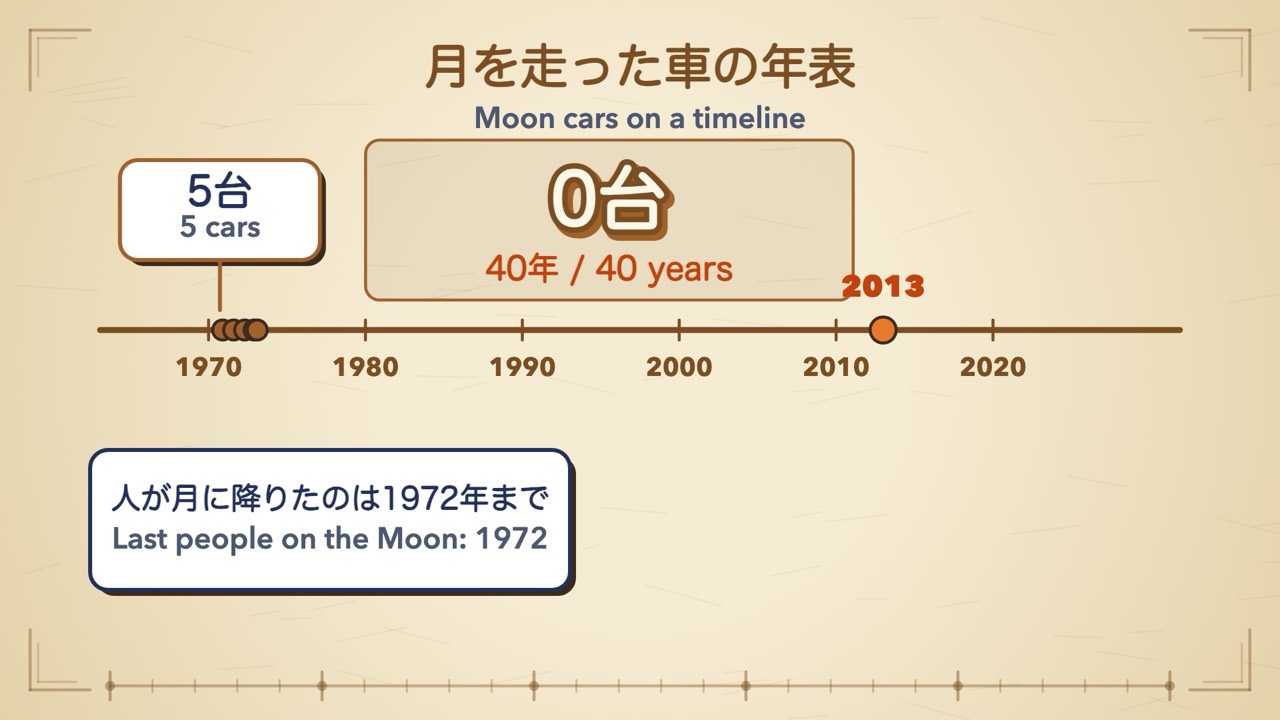
Because from the day Lunokhod 2 stopped in 1973 until 2013, a span of forty years, not a single car drove on the Moon, so there was nothing there to even try to beat the record.
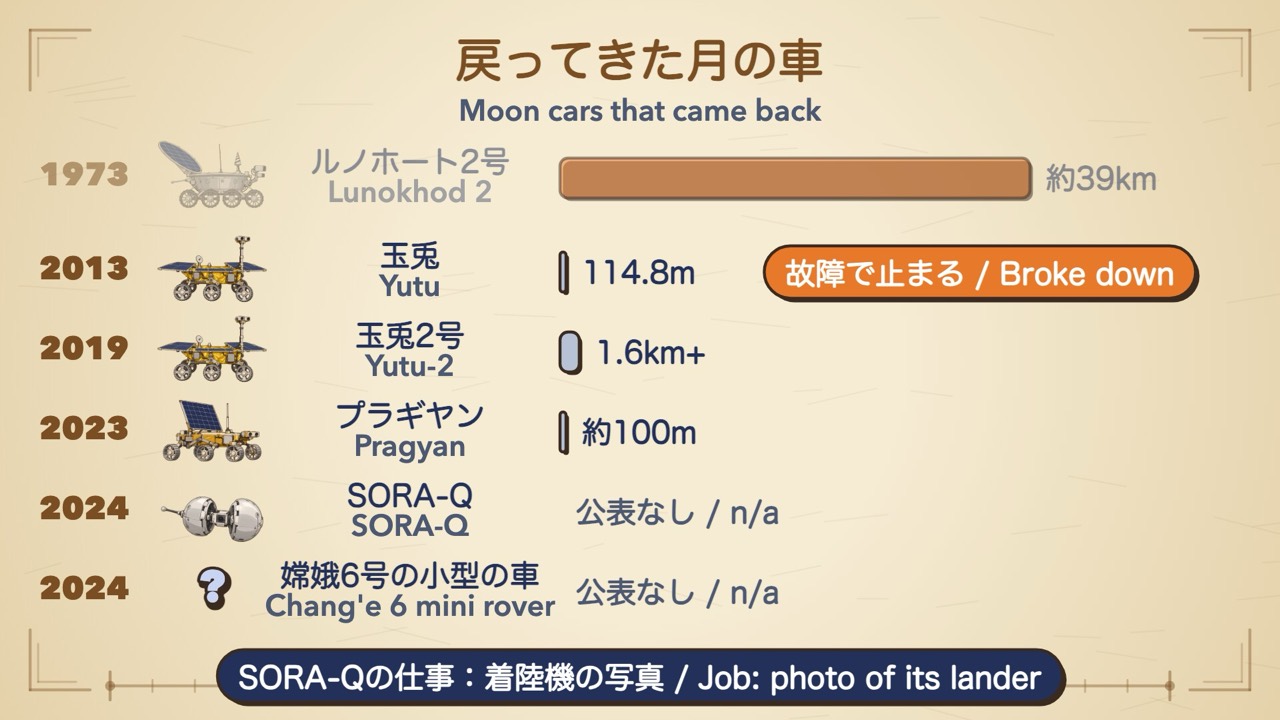
The Moon cars that came back from 2013 on didn't come anywhere near Lunokhod 2's roughly 39 kilometers: Yutu stopped after 114.8 meters when it broke down, and Yutu-2 had driven a little over 1.6 kilometers as of September 2024.
The record was finally broken by a Mars rover, not a Moon car: Opportunity, one of twin rovers planned to work for about ninety days, just kept going and passed it in 2014.
Watch the video (6 min 34 sec)
Chapters (11)
Full transcript
0:00A record unbeaten for 41 years
NaruIn 1973, a car on the Moon drove 39 kilometers.
NaruThe farthest anyone had ever driven beyond Earth.
NaruAnd that record...
Naruwent unbeaten for forty-one years.
NaruOn the Moon itself, it's still number one today.
NaruMeanwhile, telephones turned into smartphones.
DirectorWhy can't anyone beat a fifty-year-old car? Go check every last one!
NaruHe wants me to check every car that has ever driven on the ground of the Moon and Mars.
NaruThe answer lies in an empty forty years on the timeline.
NaruAnd at the end, a table of all sixteen.
NaruMarusuke's Naruhodo Lab!
NaruFirst report! The Moon is close, so I bet they could drive it from Earth while watching!
0:46Because the Moon is close?
DirectorRejected!
Naru...He says the Moon was just as close for every Moon car after it. So why couldn't they beat it?
NaruIt's true that Lunokhod 2 was driven by a team on Earth, watching pictures sent back from the rover.
NaruRadio reaches the Moon in about 1.3 seconds. But it's just as close today.
NaruSo why couldn't anyone beat it? Let's line up every car that has driven on the Moon.
NaruThe Soviet Lunokhod 1 landed on the Moon in 1970 and drove 10.5 kilometers in all by the next year.
1:22Moon cars, 1970-73
NaruFrom 1971, astronauts on Apollo 15, 16 and 17 drove lunar rovers.
NaruThen in 1973, Lunokhod 2 drove 39 kilometers. From 1970 to 1973, five vehicles drove on the Moon.
NaruQuiz time!
1:53Quiz
NaruAfter Lunokhod 2, how many years passed before the next car drove on the Moon?
NaruThe answer is C: forty years later.
NaruFrom the day Lunokhod 2 stopped until 2013, not a single car drove on the Moon.
2:07An empty 40 years
NaruAmericans last landed on the Moon in 1972. And the Soviet Lunokhod 3 was finished, but never launched.
NaruThere was no car on the Moon to even try to beat the record.
NaruIn 2013, the first car on the Moon in forty years was China's Yutu. But a breakdown stopped it after 114 meters.
2:29Moon cars that came back
NaruThe next one, Yutu-2, spent years exploring the far side of the Moon. As of September 2024, it had driven a little over 1.6 kilometers.
NaruIndia's Pragyan drove about 100 meters. Japan's palm-sized SORA-Q tested tiny-robot technology and photographed its lander.
NaruPragyan was only ever planned for one lunar day, about fourteen days. Yutu-2's plan was three months.
NaruAnd a lunar night lasts two weeks. Yutu-2 sleeps through every night, and rests in the midday heat, too.
NaruThe Moon cars that came back didn't come anywhere near 39 kilometers.
NaruSo who finally broke the record, forty-one years later?
3:22Who broke it? The Mars twins
NaruNot a Moon car. A Mars rover.
NaruIn January 2004, NASA landed two identical rovers on opposite sides of Mars: the twins, Spirit and Opportunity.
NaruTheir job was to look for clues that ancient Mars had water. Each was planned to work for about ninety days.
NaruSpirit drove 7.7 kilometers, got stuck in soft sand, and fell silent in 2010.
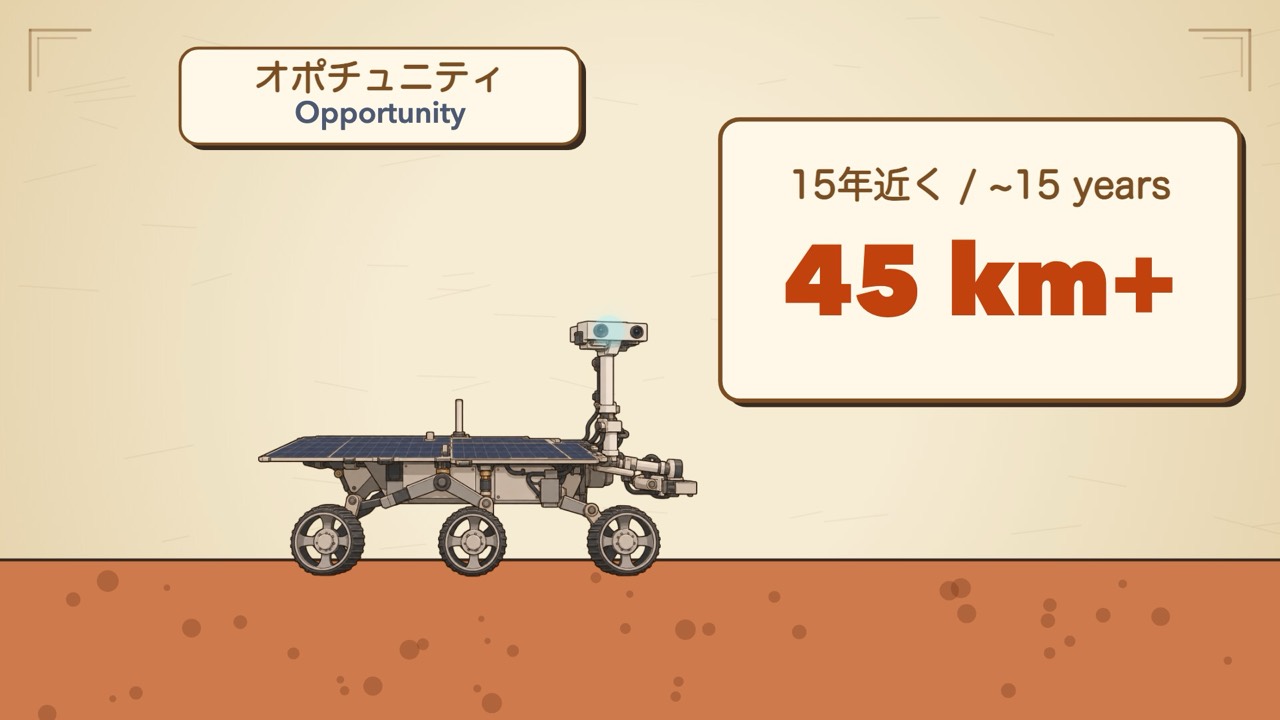
NaruOpportunity, meant to drive about one kilometer, just kept going, and in 2014 it finally beat the Moon record.
NaruIt kept working after that, almost fifteen years in all, and drove more than 45 kilometers.
NaruMars rovers stop to study rocks and soil as they go. On top of that, Mars is far: radio takes a few minutes to over twenty minutes, one way.
4:13Mars is far
NaruYou can't drive while watching. A team on Earth picks where to go and sends it up, and the rover usually drives the next day.
NaruEven when Opportunity picked its own way, it stopped after every short stretch to check its pictures.
NaruThen, on October 11, 2026, the record changed again.
4:38The 2026 record
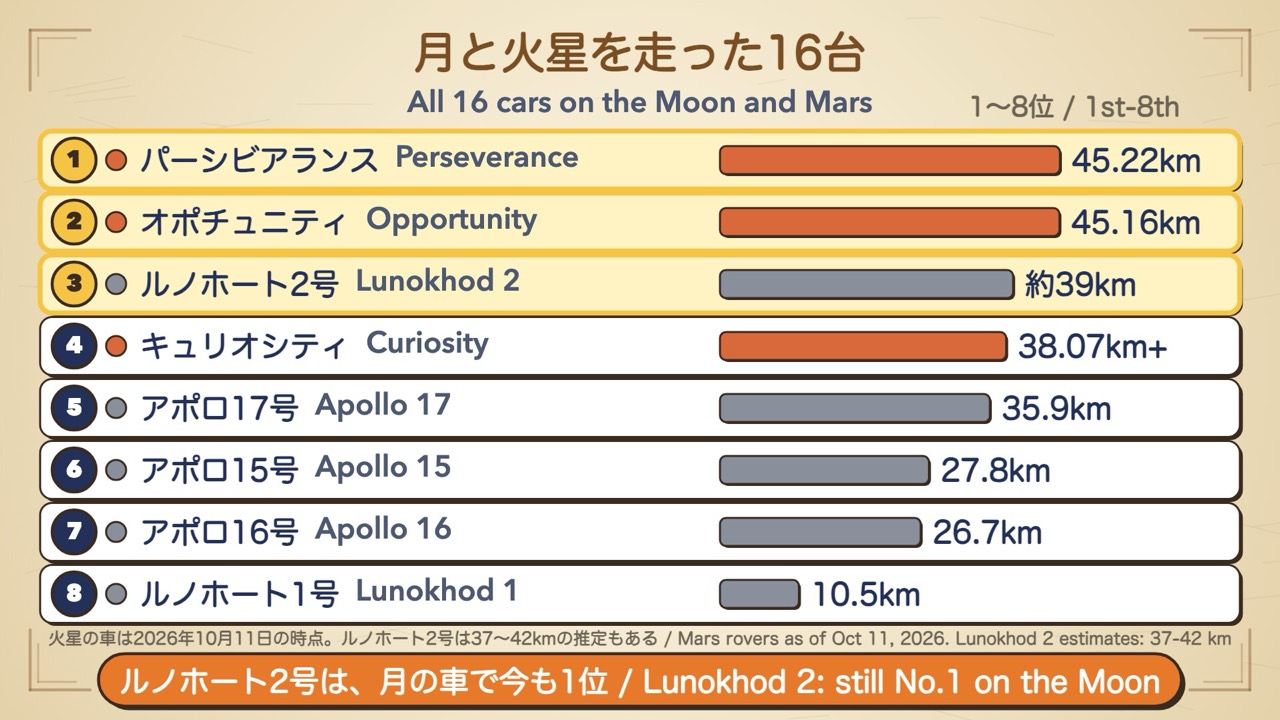
NaruPerseverance reached 45.22 kilometers, covering in five and a half years what took Opportunity almost fifteen.
NaruOne big reason it got faster: thinking while driving.
NaruIts dedicated computer spots hazards in the ground while the wheels keep turning. NASA says it used this system to check the terrain for more than ninety percent of the distance.
NaruThat's every car that has rolled across the ground of the Moon and Mars: ten on the Moon and six on Mars. Sixteen in all.
5:10All 16 cars
NaruOnly the three Apollo rovers carried people. And no car has ever driven on Venus.
NaruFirst place: Perseverance. Second: Opportunity. And third, the Moon's Lunokhod 2, still number one among Moon cars.
NaruWhy the Moon record stood for forty-one years: One, for forty years, no car drove on the Moon. Two, the Moon cars that came back never got near 39 kilometers. Three, the one that beat it was a Mars rover planned for ninety days that just kept going. Naruhodo!
5:36Summary
NaruWhen a record stands for a long time, maybe it's not that no one could beat it, but that no one was trying.
Director...I see. That fifty-year-old car was really something.
NaruThe Director stamped it PASSED!
NaruWhich world would you send a car to next? Tell us in the comments.
NaruThis has been Marusuke's Naruhodo Lab!
NaruIf you went "naruhodo!", please hit like and subscribe!
See it in pictures
More details
What kind of car was Lunokhod 2?
A Soviet Moon car that landed on January 15, 1973. A team on Earth drove it while watching pictures sent back from the rover, and it covered about 39 kilometers on the Moon, passing the previous off-world record set by the Apollo 17 lunar rover in 1972 (35.9 km).
Its distance has also been estimated at 37 km and 42 km. Here we use NASA's figure of about 39 km.
How is driving on the Moon different from driving on Mars?
Radio reaches the Moon in about 1.3 seconds, one way. A team on Earth could drive Lunokhod 2 while watching its pictures.
Radio takes a few minutes to over twenty minutes to reach Mars, one way. You can't drive while watching: a team on Earth picks where to go and sends it up, and the rover usually drives the next day. Even when Opportunity picked its own way, it stopped after every short stretch to check its pictures.
On top of that, Mars rovers stop to study rocks and soil as they go. How many years a drive takes isn't decided by driving speed alone.
What happened on the Moon between 1973 and 2013?
Five vehicles drove on the Moon from 1970 to 1973: the Soviet Lunokhod 1, which landed in 1970 and drove 10.5 km in all by the next year; the lunar rovers of Apollo 15, 16 and 17 (1971–72), driven by astronauts; and Lunokhod 2 in 1973.
Americans last landed on the Moon in 1972. The Soviet Lunokhod 3 was finished but never launched. Even among landers, after Luna 24 brought back samples in 1976 (it carried no car), the next one to touch down was China's Chang'e 3, with Yutu, in December 2013.
There was no car on the Moon to even try to beat the record.
Why didn't the Moon cars that came back reach 39 km?
Each had its own story. China's Yutu (December 2013) stopped after 114.8 meters when it broke down.
Yutu-2 (January 2019, on the far side of the Moon) far outlived its three-month plan and spent years doing science; as of September 2024, it had driven a little over 1.6 km. A lunar night lasts two weeks, and Yutu-2 sleeps through every night and rests in the midday heat, too.
India's Pragyan (August 2023) was planned for one lunar day, about 14 days, and drove about 100 meters. Japan's palm-sized SORA-Q (January 2024) tested tiny-robot technology and photographed its lander. Neither SORA-Q nor the Chang'e 6 mini rover (June 2024) has a published distance.
What were the Mars twins?
In January 2004, NASA landed two identical rovers, Spirit and Opportunity, on opposite sides of Mars. Their job was to look for clues that ancient Mars had water. Each was planned to work for about ninety days.
Spirit drove 7.7 kilometers, got stuck in soft sand, and fell silent in 2010.
Opportunity, meant to drive about one kilometer, just kept going and beat the Moon record on July 27, 2014, at 40.25 km. It kept working after that, almost fifteen years in all, and drove 45.16 km.
Where does the record stand now?
On October 11, 2026, the Mars rover Perseverance reached 45.22 km and passed Opportunity, covering in five and a half years what took Opportunity almost fifteen.
One big reason it got faster: thinking while driving. Its dedicated computer spots hazards in the ground while the wheels keep turning. NASA says it used this system to check the terrain for more than ninety percent of the distance.
Sixteen vehicles have rolled across the ground of the Moon and Mars: ten on the Moon and six on Mars. (Hoppers, helicopters, hand-pulled carts and rovers that never reached the ground aren't counted.) No car has ever driven on Venus.
 Takeaway
When a record seems stuck, check whether anyone is even trying. Maybe it's not that no one could beat it, but that no one was trying.
How we checked
- NASA JPL (Oct 12, 2026)
- NASA JPL (Jul 2014)
- LROC (Lunokhod 2)
- NASA NSSDCA (Apollo rovers)
- NASA NSSDCA (lunar timeline)
- RG (Lunokhod 3, 2014)
- Guangming Online (Yutu-2, Sep 2024)
- The Planetary Society (Chang'e 4)
- ISRO (Chandrayaan-3)
- JAXA (SORA-Q, Jun 2026)
- NASA (Spirit and Opportunity)
- NASA JPL (Sep 2023)
People and several AIs checked the video script against the text of the sources above and fixed misleading wording (October 15, 2026). Numbers are as of that date. AI wrote this page from that script and those sources, and a person checked it before publishing. If you spot a mistake, please email marusukelab@gmail.com.
Next questions
- People walked on the Moon over 50 years ago. So why is NASA offering prize money over static electricity now?
- Halley's Comet comes once every 76 years, so why do its pieces become shooting stars every year?
- Why did one person's week seem to use more than 10 times the tokens of Anthropic's big study?